The Battle for Cross-Platform Supremacy
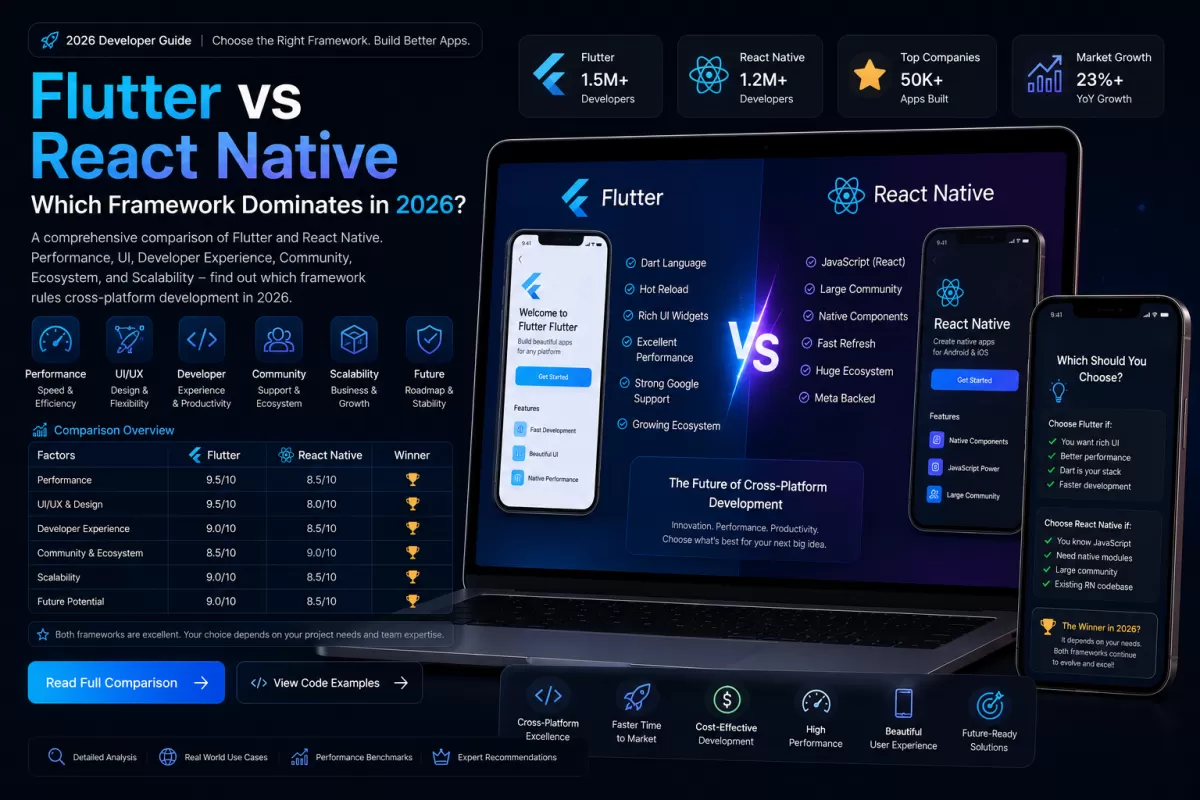
When it comes to building mobile applications for iOS and Android simultaneously, two frameworks have consistently battled for the top spot: Google'sFlutterand Facebook'sReact Native. As we move deep into 2026, the landscape has shifted, and both frameworks have evolved significantly.
The Core Philosophies
To understand which framework is better for your specific use case, you must understand how they operate under the hood.
- React Native:Uses JavaScript (and TypeScript) to communicate with native iOS and Android components via a "bridge". When you render a React Native button, it is actually rendering a true native iOS
UIButtonor AndroidButton. - Flutter:Uses the Dart programming language and skips the bridge entirely. Flutter draws every single pixel on the screen using its own high-performance rendering engine (Impeller).
1. Performance Showdown
Because Flutter compiles directly to native ARM code and draws its own UI, it boasts incredibly smooth 60fps (and 120fps) animations. It is highly suited for applications with complex UIs, custom animations, and heavy graphical requirements.
React Native has made massive strides with its New Architecture and Fabric renderer, minimizing the cost of the JavaScript bridge. For 95% of standard CRUD applications (e-commerce, social media, news feeds), React Native's performance is indistinguishable from a purely native app.
2. The Developer Experience and Ecosystem
React Native wins the ecosystem battle.Because it is based on JavaScript and React, any web developer who knows React can transition to React Native within weeks.
Flutter wins the developer experience battle.Dart is a strictly typed, incredibly robust language. Flutter's tooling, documentation, and "Hot Reload" feature are legendary for being stable and reliable.
Feature Comparison Matrix
| Feature | Flutter | React Native |
|---|---|---|
| Programming Language | Dart | JavaScript / TypeScript |
| Rendering | Custom UI Engine (Impeller) | Native UI Components via Bridge |
| Talent Pool | Growing, but niche | Massive (Web developers transition easily) |
When to Choose Which?
Choose Flutter if:You are building a highly customized UI, a financial app that requires absolute pixel-perfection across devices, or an app with heavy, complex animations.
Choose React Native if:You already have a team of React developers, your app requires deep integration with third-party native libraries, or you want to share business logic heavily between your web app and mobile app.