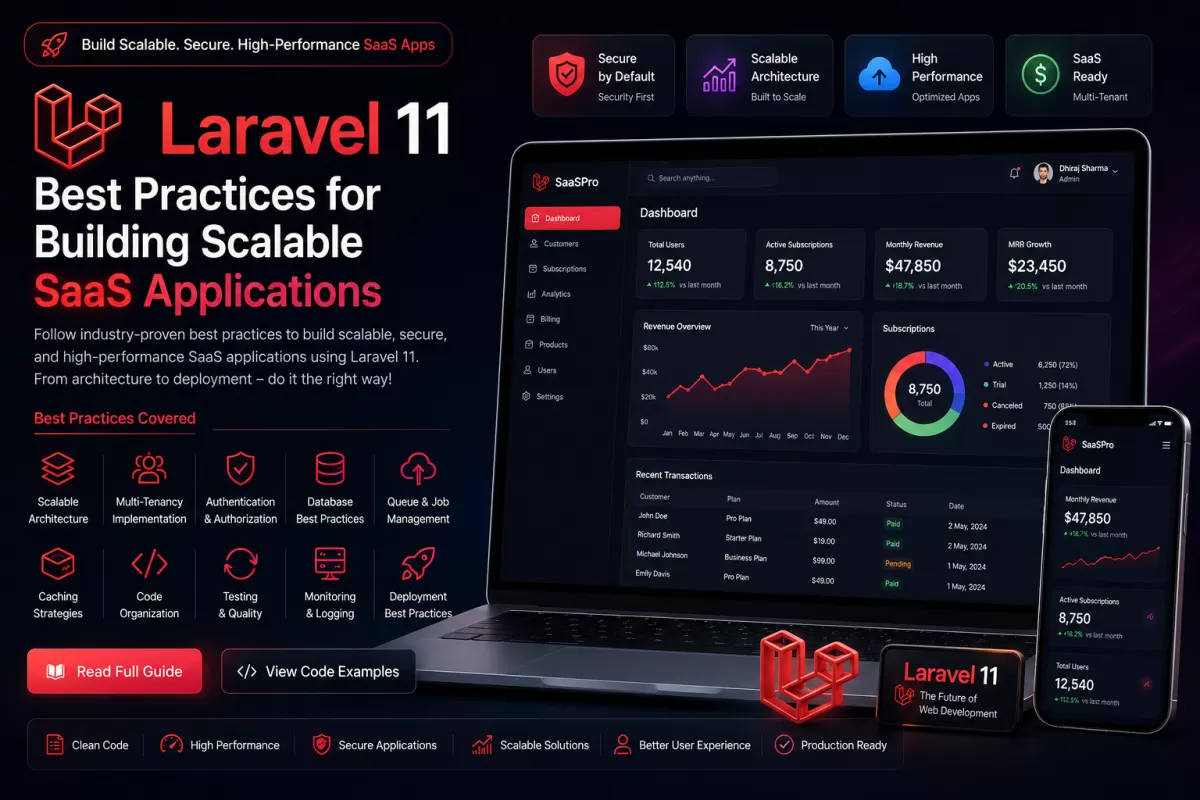
Laravel 11 Best Practices for Building Scalable SaaS Applications
The Evolution of SaaS in Laravel 11
Building a Software as a Service (SaaS) platform is one of the most lucrative software engineering endeavors today. Laravel 11 has streamlined the process significantly by removing boilerplate code and offering a highly opinionated, yet flexible architecture. However, scaling a SaaS from 100 users to 100,000 users requires careful planning, robust architecture, and a deep understanding of Laravel's core features.
In this comprehensive guide, we will explore the absolute best practices for building highly scalable SaaS applications in Laravel 11.
1. Master the Art of Queues and Background Jobs
The number one mistake junior developers make is executing heavy processes synchronously. If a user uploads a video, generates an invoice, or triggers a bulk email, they should never have to wait for the page to load.
Always push these tasks to Laravel Queues using Redis or Amazon SQS.
namespace App\Jobs; use Illuminate\Contracts\Queue\ShouldQueue; use Illuminate\Foundation\Queue\Queueable; use App\Models\Invoice; class GenerateMonthlyInvoices implements ShouldQueue { use Queueable; public function __construct(public Invoice $invoice) {} public function handle(): void { // Heavy PDF generation logic here $this->invoice->generatePdf(); } }By dispatching this job, the user receives an instant response while the server works in the background:GenerateMonthlyInvoices::dispatch($invoice);
2. Designing a Bulletproof Multi-Tenancy Strategy
Every SaaS relies on multi-tenancy (multiple customers using the same application instance). There are two primary ways to handle this in Laravel:
- Single Database (Row-level Isolation):Every table has a
tenant_id. This is the easiest to maintain but poses a risk if you accidentally query data without scoping thetenant_id. Always use Laravel Global Scopes to automatically filter queries by the authenticated user's tenant. - Multi-Database (Database-level Isolation):Every customer gets their own database. This is incredibly secure and scales infinitely, but running migrations across 10,000 databases can be a nightmare. Packages likeStancl/Tenancymake this easier.
3. Aggressive Caching Strategies
Database queries are the bottleneck of almost every web application. If a piece of data doesn't change every second, cache it!
use Illuminate\Support\Facades\Cache; $dashboardData = Cache::remember('user_dashboard_'.auth()->id(), now()->addHours(1), function () { return [ 'total_revenue' =>auth()->user()->calculateRevenue(), 'active_tickets' =>auth()->user()->tickets()->where('status', 'open')->count(), ]; });Conclusion
Scaling a Laravel SaaS is not about writing clever code; it's about writing predictable, maintainable, and optimized code. By utilizing queues, respecting multi-tenancy architecture, and caching aggressively, your Laravel 11 application will be ready to handle millions of requests flawlessly.